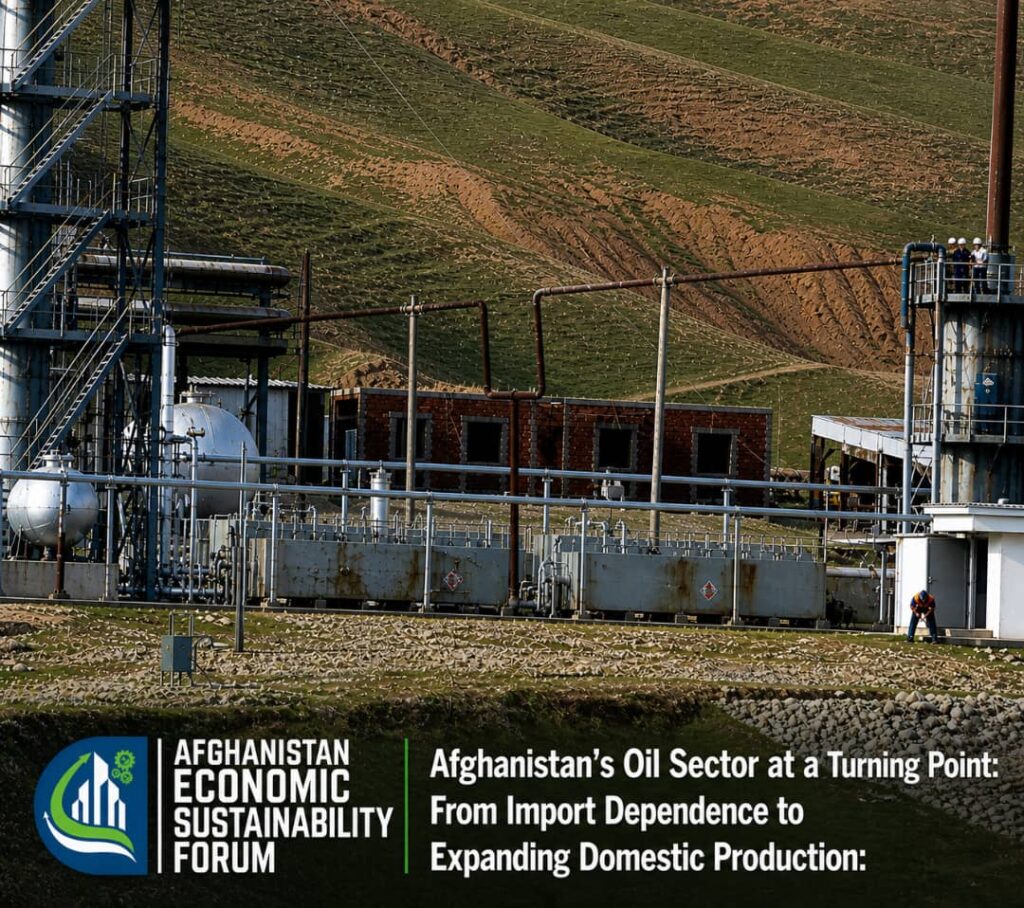
According to the Ministry of Mines and Petroleum, the country currently imports nearly 3 million tons of oil annually from countries such as Iran, Turkmenistan, and Russia to meet its energy needs. However, recent developments in domestic extraction are beginning to shift this trend.
Officials report that oil production in the Amu Darya basin, particularly in the Qashqari block, has increased, enabling Afghanistan to supply approximately 15.7% of its daily oil consumption from internal sources.
The ministry has also outlined new development plans aimed at expanding extraction capacity. Under these plans, domestic oil production is expected to rise significantly, with projections indicating that up to 29.75% of the country’s oil demand could be met locally in the near future.
AESF Economic Insights,
Increasing domestic oil production marks a critical shift in Afghanistan energy economics, reflecting the principle of “import substitution industrialization”, where local production replaces costly imports. In the short term, producing 15.7% of oil domestically reduces import bills, eases pressure on foreign exchange reserves, and improves energy security in the period of global and regional crisis, which is vital for a highly import dependent economy. If production rises toward the projected 29.75%, the country could further stabilize fuel prices and reduce vulnerability to external shocks. However, the transition also highlights structural challenges such as the need for infrastructure, technical capacity, and investment. In the long term, if managed efficiently with transparent policies and reinvestment of resource revenues, the oil sector could support industrial growth and fiscal stability; otherwise, there is a risk of falling into the “resource curse,” where weak governance undermines the broader economic benefits of natural resource wealth consumption.
By: Obaidurahman Niazi AESFnews Reporter